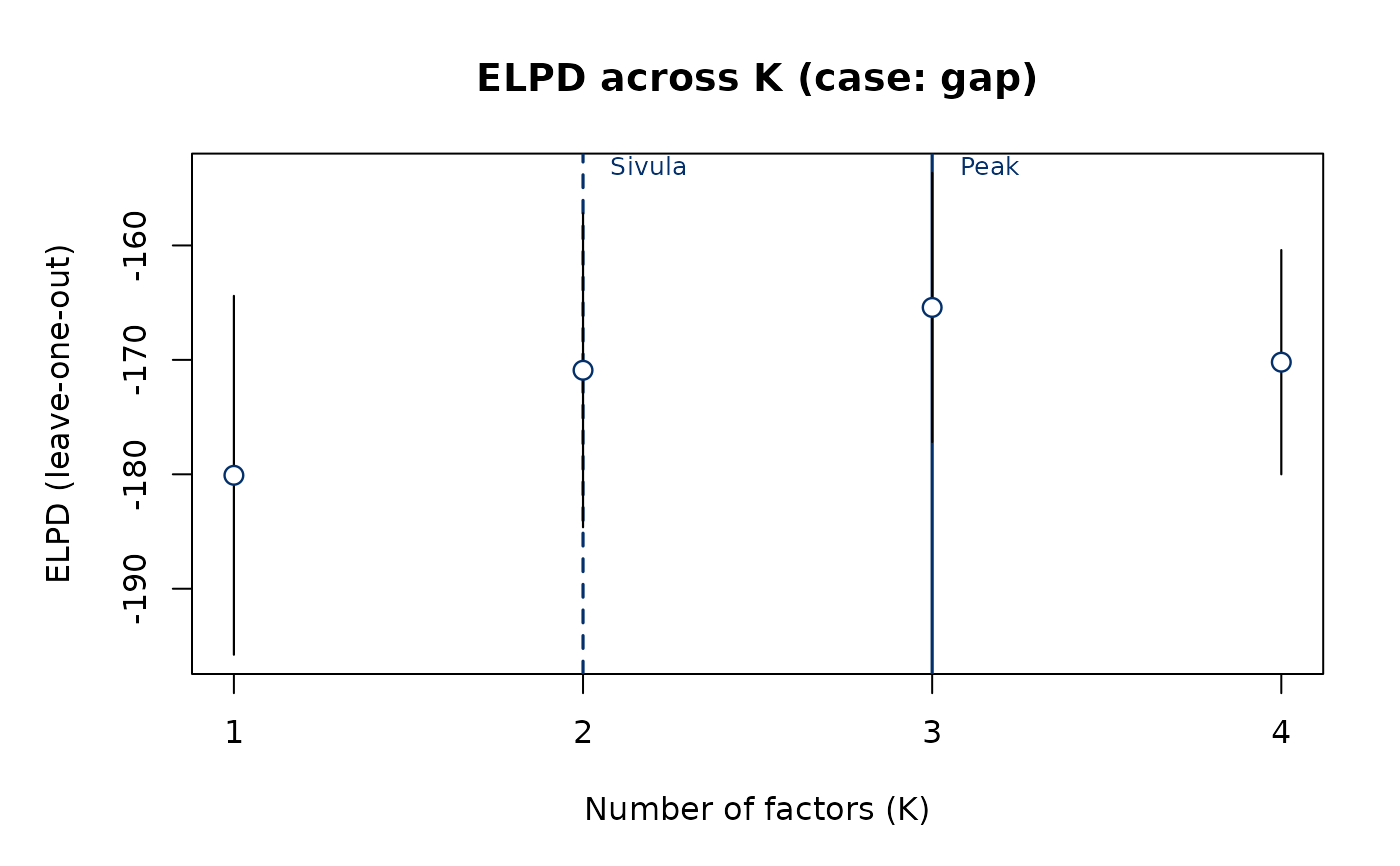
Returns a bayesqm_run object carrying a plausible ELPD trajectory
across K = 1..K_max, with user-chosen peak K, Sivula K, and case
label. Use it to demonstrate run_bayes() output and
plot_elpd() without a Stan backend; it is not a substitute for
run_bayes() on real data.
Usage
demo_run(
  K_max = 4L,
  k_peak = 3L,
  k_sivula = 2L,
  case = c("gap", "agree", "reversed"),
  seed = 1L
)Examples
run <- demo_run()
run
#> Bayesian Q-methodology: multi-K comparison
#>   K range:      1..4
#>   ELPD peak:    K = 3  (automated adoption)
#>   Sivula rule:  K = 2  (parsimony diagnostic)
#>   Case:         gap  (ELPD peak > Sivula (weak discrimination between adjacent models))
#>
#> LOO comparison:
#>  K    elpd   se delta_elpd se_delta ratio
#>  1 -180.09 8.00
#>  2 -170.91 7.00      -9.18     3.00  3.06
#>  3 -165.42 6.00      -5.49     3.00  1.83
#>  4 -170.20 5.00       4.78     3.00  1.59
#>
#> Case 'gap': k_peak is adopted; Sivula is reported as a parsimony diagnostic only.
plot_elpd(run)